 my.CSMD
Future Engineers on Display as CSM Hosts Regional Robotics Tournaments
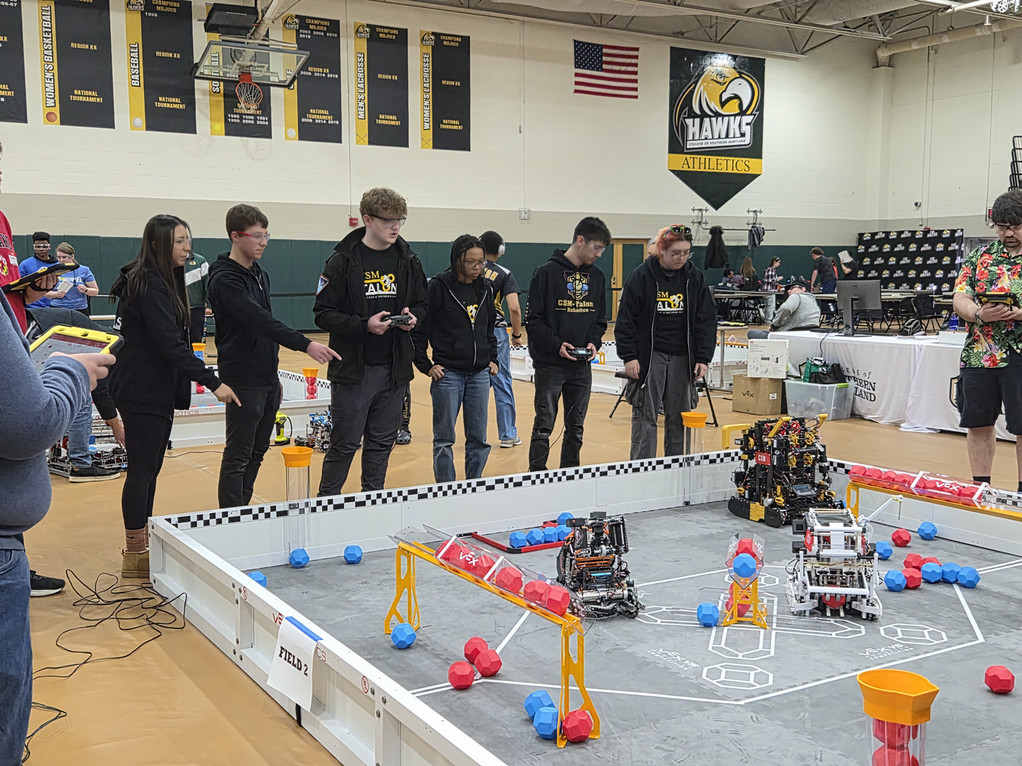
Hundreds of students from across the region traveled to the College of Southern Maryland (CSM) in January and February to showcase their engineering skills during a series of VEX Robotics competitions.
Separate tournaments were held on the CSM La Plata Campus for elementary and middle school, high school, and college level teams. Competitors demonstrated their ability to design, build, test, and operate robots to complete task-based challenges, applying teamwork, problem-solving, and critical thinking along the way.
More than 20 elementary and middle school teams competed in the VEX IQ tournament on Jan. 24, and on Feb. 7, more than 30 regional high school teams filled the CSM Physical Education Center to put their robots to the test. Talons robotics team members supported both competitions as referees, scorekeepers, and judges, providing mentorship and leadership for younger participants.
The CSM Talons Robotics team stood out at the Feb. 6 college-level competition, sweeping every match and outscoring four other teams from four-year universities.
Talons team member Alexander Hawe said the win was a major confidence boost. “We had some setbacks and went through a full redesign from the robot we had in Manassas,” he said, referring to a November tournament in November. “After all that hard work, I’m glad that it went well and it all paid off.”
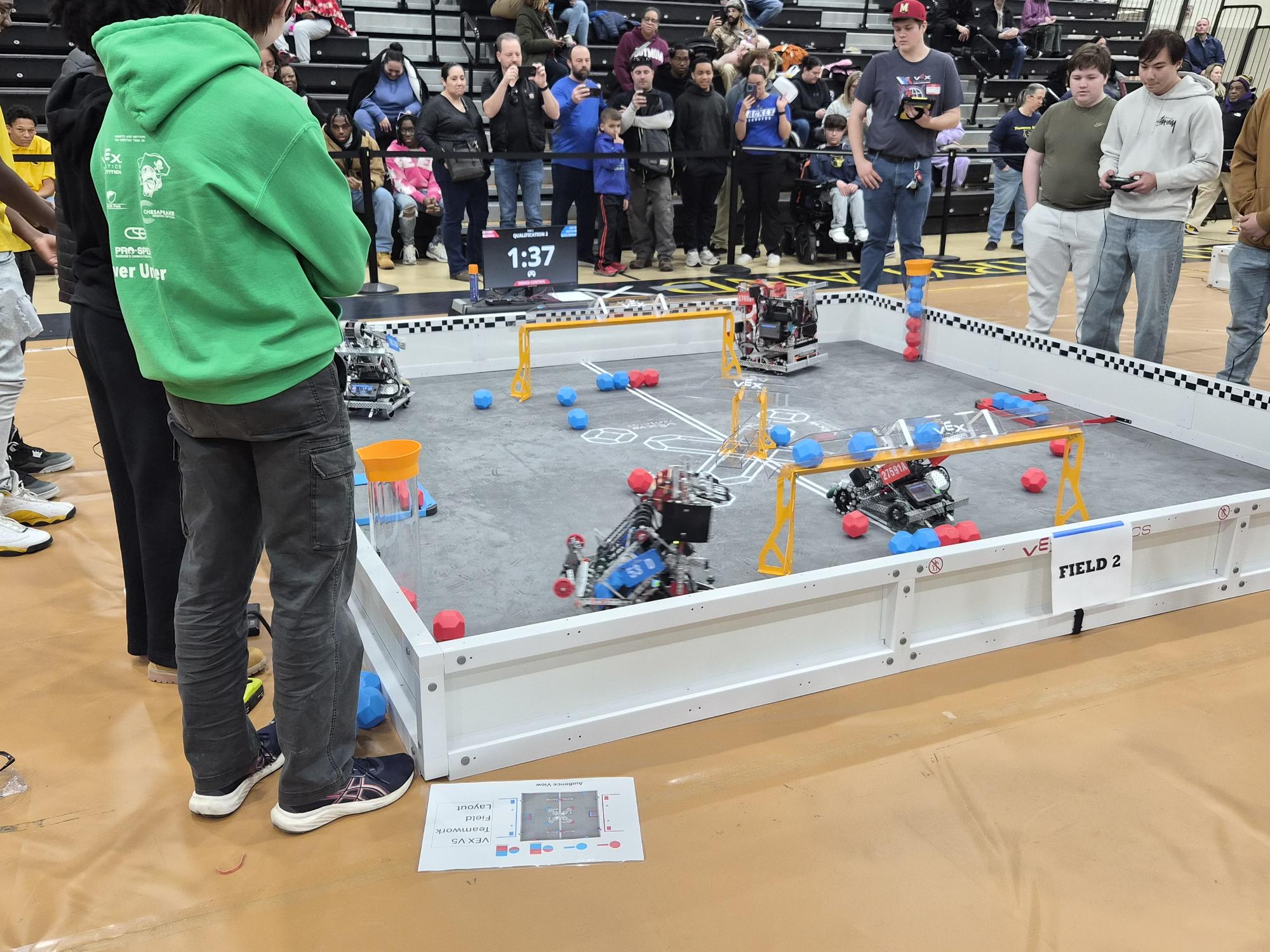 Each year, VEX Robotics presents a new game field to challenge competitors’ engineering skills. This year’s field for university and high school competition is called Push Back. Tall cylinders are placed in each corner and filled with red and blue balls. The field has three goals, one in the center and two on opposite sides. Teams score points by moving the balls from the cylinders to the goals, and by pushing the opposing team’s balls out.
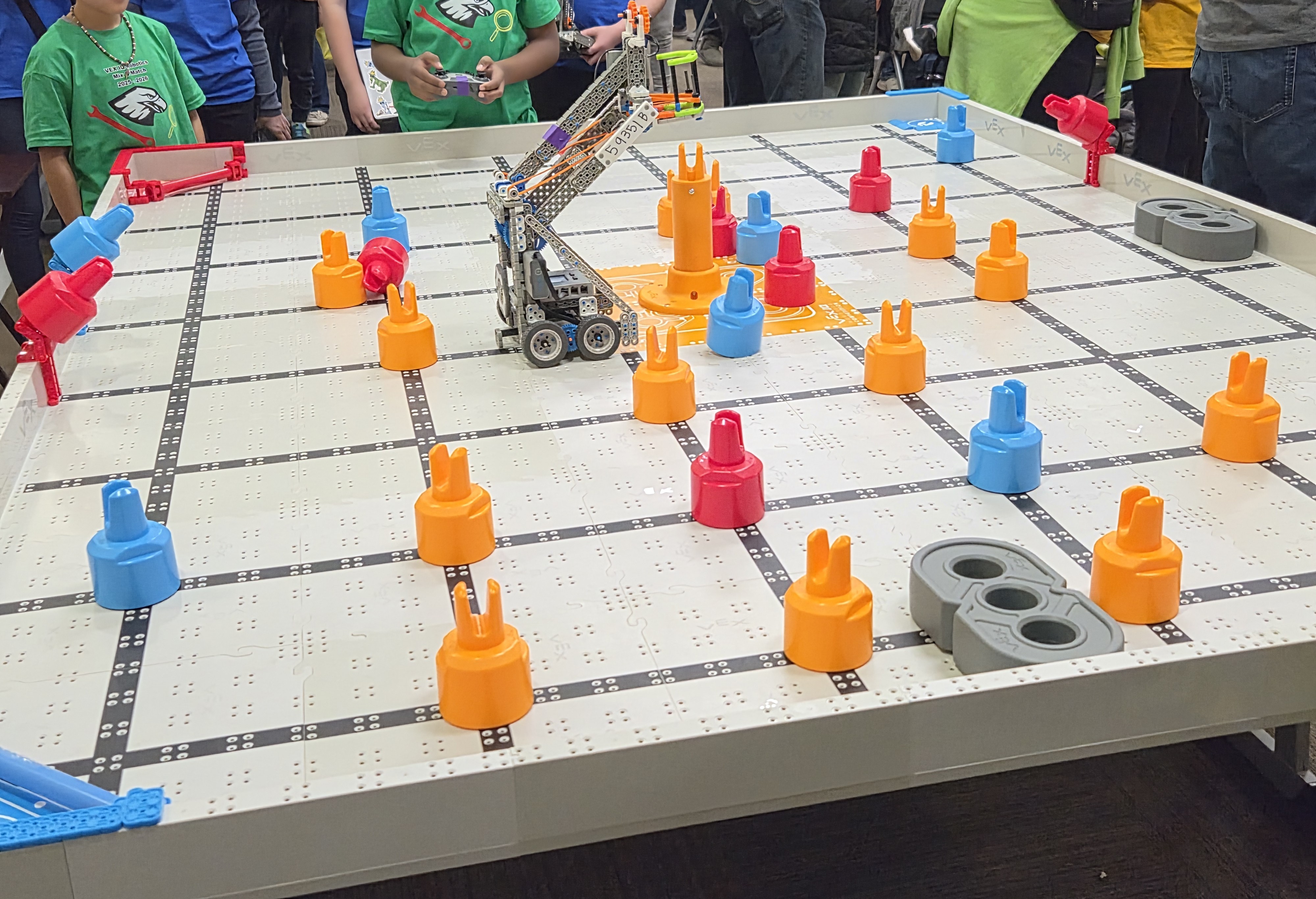 The elementary and middle school game is called Mix and Match. Yellow, red, and blue pins are placed around the field with a tall goal in the middle. Teams score points by stacking different colored pins and placing them on the center goal.
Hawe said the competitions make him a better engineer by applying classroom skills to real-world challenges.
“You can go to class and get good grades, but to be a good engineer you need to apply your skills somewhere,” Hawe said. “The Talons [team] has all parts of the engineering process, from design and prototyping to building and testing. You’re not constrained to do one thing, so it’s any easy place to learn and explore different roles.”
Talons team member Michael McGrath emphasized the value of early exposure to robotics, and how it can set a foundation for a future engineering career.
“They’re going to be the next generation of engineers. Hands-on experience at an early age helps them develop an interest in engineering, get started along that path, and build their skills. Getting started earlier will give them an advantage.”
McGrath, a sophomore engineering student, plans to transfer to the University of Maryland to pursue mechanical engineering after graduating from CSM. He said the team has given him an opportunity to prepare for his next step in higher education.
“The team has been a wonderful opportunity to gain real-life, hands-on experience working in a relevant field,” McGrath said. “When I first joined, I knew very little about robotics, but I was able to step in and fill a role. We’ve had a lot of people step up, and it’s nice to see all the work we put in pay off.”
The Talons have two more competitions this spring where they hope to earn a ticket to the World Championships in May.
These events were made possible through the leadership of CSM faculty, staff, volunteers, and community partners, including Professors Ann Stine and Eugen Leontie, whose coordination helped bring hundreds of future engineers to campus.